Reasoning
Critical Thinking
The discipline of noticing when a piece of writing is asking for your agreement instead of your judgment.
TL;DRCritical thinking is not cynicism, and it is not the reflex to disagree with everything. It is the habit of pausing between encountering a claim and accepting it — long enough to ask what evidence supports it, who benefits if you believe it, and whether the feeling it just produced in you is doing the persuading instead of the facts. That gap has never mattered more. Feeds are optimized for engagement, not accuracy; AI-generated text can produce a confident, fluent paragraph on any side of any argument in seconds; and the sheer volume of claims competing for your attention makes careful evaluation feel like a luxury you don't have time for. It is one of the highest-leverage skills available, precisely because so much of what reaches you is optimized to make you skip it.
Emotional Manipulation in Writing
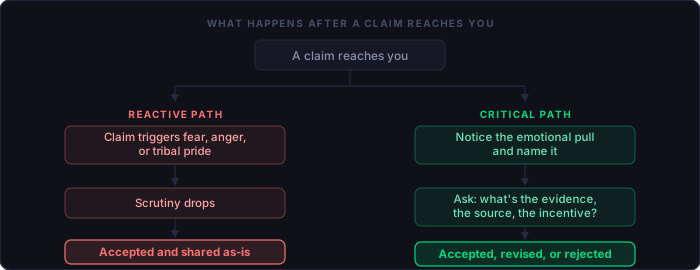
Persuasive writing routinely bypasses evaluation by triggering a feeling strong enough that the reader reacts before they analyze. None of the techniques below are inherently proof that a claim is false — but each one substitutes a feeling for an argument, and a piece that leans on several of them at once is asking to be believed rather than earning it.
Fear and Threat Appeals
Framing a claim around an imminent danger to the reader or the people they care about. Fear narrows attention and shortens the time a reader spends weighing alternatives — it is a survival response, not a reasoning one.
"If this policy passes, everything you've worked for will be gone within a year."
False Urgency and Manufactured Scarcity
Compressing the decision window so there is no time to check sources or sleep on it. Genuine deadlines exist; the tell is a deadline that serves no purpose except to prevent verification.
"Share this before it gets taken down. You won't see this again."
Outrage Bait
Presenting the most extreme, least representative example of an opposing position as if it were typical. Anger is one of the most shareable emotions, which makes it one of the most profitable to trigger — accuracy about how representative the example actually is tends to be the first casualty.
Loaded Language and Framing
Choosing words that carry a judgment the facts alone don't support. The same policy can be called "bold" or "reckless," the same person "a whistleblower" or "a leaker," with no change to the underlying facts — only to how the reader is nudged to feel about them before they've evaluated anything.
Bandwagon Appeals
Substituting the appearance of consensus for evidence. "Everyone agrees" and "no serious person disputes this" are claims about popularity, not about truth, and they discourage the reader from checking whether the underlying claim actually holds up.
Ad Hominem and False Dichotomy
Attacking the source of a claim instead of the claim itself, or reducing a nuanced issue to exactly two options — one clearly monstrous — so that rejecting the monstrous option looks like accepting the other by default. Both techniques let the reader feel like they've reasoned their way to a conclusion when they've actually just been steered around it.
Common Forms of Cognitive Bias
Emotional manipulation is something writing does to you. Cognitive bias is something your own reasoning does on its own, with no manipulator required. Both distort judgment in the same direction — toward the conclusion that was easiest, not the one best supported by evidence — which is why persuasive writing so often works by finding the bias that's already there and giving it something to grab onto.
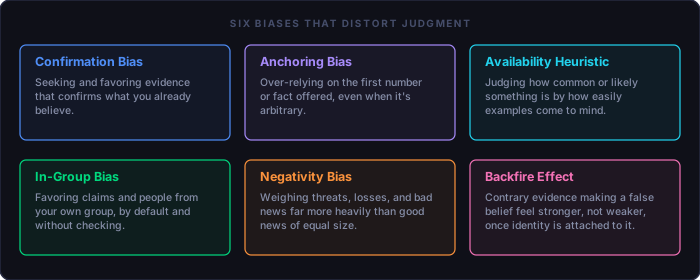
Confirmation Bias
The tendency to seek out, notice, and remember evidence that confirms what you already believe, while giving disconfirming evidence less attention or a harsher standard of proof. It is the single most consequential bias for critical thinking because it operates before you're aware any evaluation is happening — you don't feel like you're avoiding counter-evidence, you just never went looking for it.
Anchoring Bias
Over-relying on the first number or fact presented, even when it is arbitrary, and judging everything that follows relative to it rather than on its own terms. A price, a statistic, or an estimate mentioned early in a piece keeps exerting pull on the reader's judgment long after it should have been discarded.
Availability Heuristic
Judging how common or how risky something is by how easily examples come to mind, rather than by actual base rates. Vivid, recent, heavily covered events feel far more probable than they are, while common but unremarkable risks feel rarer than they are.
In-Group Bias
Extending more trust and charitable interpretation to claims and people perceived as part of your own group, and more skepticism to the same claim from an outsider — independent of the quality of the argument in either case.
Negativity Bias
Weighing threats, losses, and bad news more heavily than gains or good news of equal size or probability. It is part of why fear appeals and outrage bait are so effective: they are exploiting a real, built-in asymmetry in how information gets weighed, not inventing one.
The Backfire Effect
Once a belief becomes tied to identity, contrary evidence can make the belief feel stronger instead of weaker — the correction gets processed as an attack to be resisted rather than information to be incorporated. It's a reason to present counter-evidence carefully, and a reason to notice when your own certainty is rising in response to being challenged rather than to being right.
Habits That Help
None of this requires distrusting everything you read. It requires a small set of habits applied consistently, especially to claims you already want to be true:
Before accepting a claim:
  [ ] Name the emotion it produced, separately from the claim itself
  [ ] Find the original source, not just whoever shared it
  [ ] Ask what evidence would change your mind — if nothing would, it's not a belief you reasoned into
  [ ] Seek out the strongest version of the opposing argument, not the weakest
The goal is not to feel nothing when you read. It is to notice the feeling, name it, and decide separately whether the claim holds up.
Further Reading
A few stable, well-established starting points if you want to go deeper on any of this:
- Foundation for Critical Thinking — a long-running nonprofit with frameworks and teaching resources on critical thinking as a discipline.
- Stanford Encyclopedia of Philosophy: Critical Thinking — a rigorous academic overview of what critical thinking is and the arguments about how to define and teach it.
- Wikipedia: List of Cognitive Biases — a comprehensive, well-sourced catalog of biases beyond the six covered here.
- Wikipedia: List of Fallacies — a reference for naming manipulative or flawed argument patterns as you encounter them.
- Your Logical Fallacy Is — short, plain-language cards for the most common fallacies, useful for building quick recognition.
- Your Bias Is — the companion project covering cognitive biases in the same quick-reference format.
- Farnam Street: Mental Models — essays and discussion on reasoning tools and biases, aimed at everyday decision-making rather than academic theory.
Checklist
Spotting emotional manipulation:
  [ ] Notice fear, outrage, or urgency the piece produced in you
  [ ] Ask what action the piece wants you to take right now
  [ ] Recast loaded language in neutral terms and see if the claim still holds
  [ ] Check whether an opposing view is being shown at its weakest, not its strongest

Checking your own biases:
  [ ] Ask what evidence would change your mind
  [ ] Notice if a vivid example is standing in for an actual base rate
  [ ] Check whether trust in a source tracks its group identity more than its track record
  [ ] Watch for growing certainty in response to being challenged, not to being right

Before you share or act:
  [ ] Trace the claim back to its original source
  [ ] Check the date — old claims get recirculated as if new
  [ ] Ask whether correlation is being presented as causation
  [ ] Wait before reacting to anything designed to make you react immediately